
How to Choose the Best Mining Dredge?
Choosing the right Mining Dredge starts with the material beneath the water, not the machine’s advertised capacity. Is the deposit loose sand, gravel, or cohesive clay? How deep is the working face? How far must the slurry travel? These details shape dredge type, pump size, cutter configuration, and operating cost. A poor match can leave valuable material behind. It can also raise fuel use and wear.
The U.S. Geological Survey’s Mineral Commodity Summaries 2024 estimates that global mine production reached about 3,000 metric tons of gold in 2023. That figure is not a dredge-market measure, but it shows the scale of a mineral sector where alluvial operations may rely on dredging. The U.S. Army Corps of Engineers’ dredging guidance likewise treats material, site conditions, and placement needs as central equipment-selection factors. Field measurements matter. A test pit, grain-size analysis, and realistic production estimate can reveal more than a brochure.
The right choice is rarely the biggest unit. It is the dredge that can handle the deposit consistently, with suitable pump performance, access, maintenance support, and recovery equipment. One limitation deserves attention: no source articles or verifiable expert quotation were supplied, so attributing a direct quote to a named Mining Dredge specialist would risk inventing one. Share a sourced quotation, and it can be incorporated accurately.
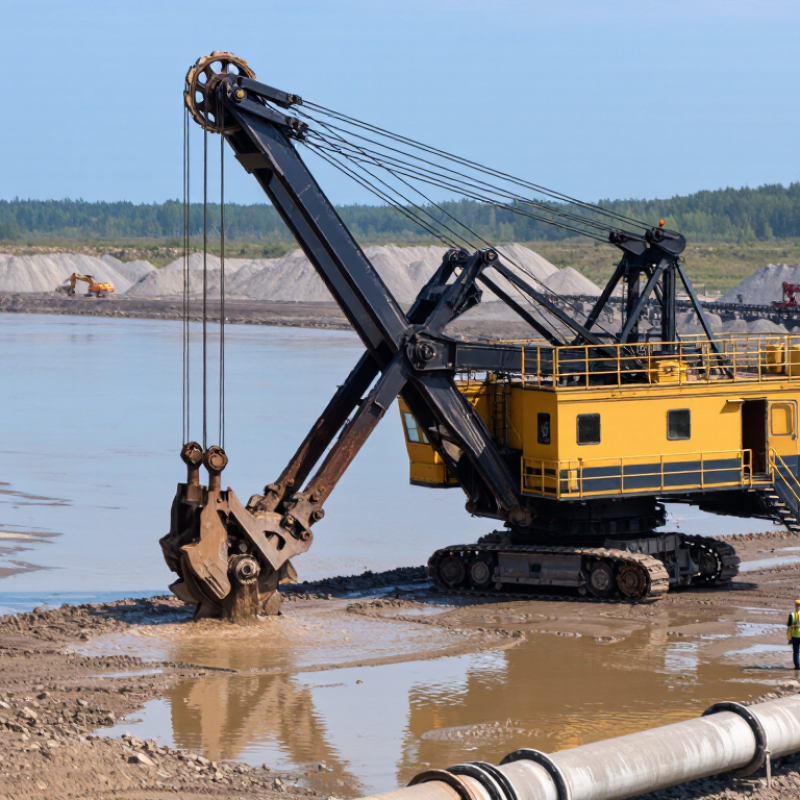
Assess the Mining Site, Water Conditions, and Material
Choosing a mining dredge begins with ground truth, not a catalogue. Map the deposit, shoreline access, working depth, and likely changes in water level. Take samples from several locations and depths; one clean-looking sample can hide a clay lens or coarse gravel. The USGS sediment-size scale classifies sand as 0.0625–2 millimeters, silt as 0.0039–0.0625 millimeters, and clay as smaller than 0.0039 millimeters. These fractions behave differently in a suction line. Sand can settle during slow flow, while sticky fines may resist separation. Gravel can increase wear on pumps and pipe bends. Small differences matter.
Check water depth at operating levels, current speed, wave exposure, and distance to discharge. A dredge that works in sheltered water may struggle where waves repeatedly disturb its intake. The U.S. Army Corps of Engineers’ engineering manual, Dredging and Dredged Material Management (EM 1110-2-5025), treats site conditions and sediment characteristics as key inputs to equipment and method selection. Use that as a planning reference, then verify conditions locally. I would not trust a single-day survey. Water levels and sediment can vary more than expected. Record flow and depth during sampling, and test whether the material contains roots, debris, or mixed layers before sizing the dredge.
How to Choose the Best Mining Dredge? — Assess the Mining Site, Water Conditions, and Material
| Assessment Dimension | Site or Material Conditions | Dredge Type to Consider | Selection Guidance | Key Checks Before Choosing |
|---|---|---|---|---|
| Loose sand and fine gravel | Unconsolidated deposits that can be drawn into a suction intake; particle size must suit the pump and pipeline. | Plain suction dredge | Often a practical choice where the deposit is loose and does not need mechanical loosening. A cutterhead can be added if the material is partly compacted. | Confirm particle-size limits, pump passage size, slurry concentration, and the risk of pipeline blockage or settling. |
| Compacted or cohesive deposits | Dense sand, clay, or layered material that resists suction and may need to be loosened before pumping. | Cutter suction dredge | A rotating cutterhead loosens the bed so material can be drawn into the suction pipe. Suitability depends on material strength, cutter design, and required production. | Assess deposit hardness, layer thickness, cutter wear, available working area, and the effect of cutting on nearby structures or slopes. |
| Coarse or abrasive material | Gravel, cobbles, or abrasive mineral-bearing sediments; oversized particles may exceed a pump’s passage capacity. | Bucket ladder or other mechanical dredge; cutter suction for pumpable sizes | Mechanical excavation can handle material that is difficult to lift by suction. For suction systems, check that the largest particles can pass through the intake, pump, and pipeline. | Determine the particle-size distribution, proportion of oversize material, abrasion potential, screening needs, and disposal or processing method. |
| Water depth and draft | Shallow ponds, variable water levels, deep pits, or restricted access for floating equipment. | Small shallow-draft suction or cutter suction dredge; mechanical dredge where access or depth is limiting | Match the dredge’s operating depth and draft to the lowest expected water level, not just the average depth. These limits vary by design. | Check minimum operating depth, draft, under-keel clearance, access channels, water-level variation, and safe mooring locations. |
| Current, waves, and wind | Still-water ponds, flowing channels, or exposed sites with waves and changing weather. | Stable, appropriately anchored floating dredge; mechanical dredge if floating operations are unsuitable | Higher current and wave exposure can affect positioning, pipeline handling, and safe operating conditions. The required anchoring and operating limits are equipment-specific. | Measure current and water-level variation; review wind and wave exposure, mooring loads, access for support craft, and weather-related shutdown criteria. |
| Discharge distance and elevation | Material must travel through a pipeline to a processing plant, settling area, or stockpile, possibly uphill. | Suction or cutter suction dredge with a pump and pipeline sized for the route | Longer pipelines, elevation gain, bends, and changing slurry properties increase pumping requirements. A booster pump may be needed after hydraulic calculations. | Map pipeline length and elevation profile; account for bends, pipe diameter, slurry density, solids settling, and access for inspection and flushing. |
| Required production and operating schedule | Production targets depend on deposit thickness, sediment properties, operating hours, and interruptions. | Choose the dredge and pump configuration after estimating site-specific production | Do not compare equipment by pump capacity alone. Actual solids production is affected by sediment concentration, excavation rate, downtime, and transport conditions. | Estimate recoverable volume, operating hours, expected solids concentration, maintenance time, and the capacity of downstream screening or processing. |
| Environmental and permitting constraints | Water-quality limits, sensitive habitats, nearby users, or restrictions on turbidity, noise, and discharge. | Any suitable dredge fitted to the site’s control and monitoring requirements | Containment, controlled excavation, and appropriate discharge management may be required. Applicable limits depend on local permits and regulations. | Review permit conditions, turbidity monitoring, discharge location, sediment testing, noise limits, and measures to prevent spills or unintended releases. |
Note: This table is a screening guide. Final selection should be based on a site survey, representative material testing, hydraulic calculations, safety review, and applicable permits. Operating limits vary by dredge design.